Alcohol health warnings on Irish labels: what goes on from 3 September 2028
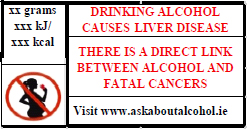
From 3 September 2028, every can and bottle of beer, cider, wine or spirits sold to someone in Ireland must carry a box with three warnings, the grams of alcohol and the calories in the container, and a website – laid out exactly as the regulations draw it.
The duty is in section 12 of the Public Health (Alcohol) Act 2018. The form – the texts, sizes, colours and typeface – is in the Public Health (Alcohol) (Labelling) Regulations 2023 (S.I. 249/2023), signed on 18 May 2023. This guide covers what goes on the container; Ireland's other labelling rules are in What goes on a beer label in Ireland?
When: 3 September 2028
The warnings were first due on 22 May 2026. On 3 September 2025 the Minister for Health moved the date: the commencement order now says that section 12 "shall come into operation 3 years after the date on which this Order is made" (S.I. 422/2025), and the labelling regulations were amended the same day in the same words (S.I. 423/2025). The Irish Statute Book's table for the Act, updated to 13 October 2026, gives "S. 12(1)-(9) | 3 September 2028". No later change had been made by then.
Drinks "offered for retail sale or supply" before that day don't need the warnings, but in a prosecution it is the seller who has to prove it (section 12(13) and (14)). A beer bottled in 2028 with a best-before date in 2029 is safest with the box.
Who and what it applies to
It is an offence "to sell, to a person who is in the State, an alcohol product the container of which does not bear in the prescribed form" the warnings and the information (section 12(1)). That covers every seller – the brewery, the shop, the online seller – and every sale to someone in Ireland, wherever the drink was made. Beer sold only in Northern Ireland or abroad isn't covered.
An "alcohol product" takes its meaning from the Finance Act 2003, section 73: beer made from malt over 0.5% vol, and wine and other fermented drinks – cider, perry, fruit wine, mead – over 1.2% vol, as well as spirits and intermediate drinks. A 0.5% beer needs no warnings.
Three cases are outside the rule for containers:
- Reusable containers, such as a growler filled at the bar: instead of a label, the drink comes with a printed document of at least A4 (section 12(2) and (3); Schedule 3 of the regulations).
- Tax-free shops for travellers leaving the State (section 12(17)).
- Stock offered for sale before 3 September 2028, as above.
The six things on the container
Section 12(1) asks for:
- a warning about the danger of alcohol consumption – "Drinking alcohol causes liver disease";
- a warning about drinking when pregnant – the pregnancy pictogram of Schedule 2;
- a warning about the direct link between alcohol and fatal cancers – "There is a direct link between alcohol and fatal cancers";
- the quantity in grams of alcohol in the container;
- the energy value in kilojoules and kilocalories in the container;
- "Visit www.askaboutalcohol.ie", the HSE's website (regulation 7(3)).
The box: exact layout and sizes
The regulations set every field's minimum size, and the fields together make one box (regulations 6 to 8 and Schedule 1):
| Field | Text | At least | Type |
|---|---|---|---|
| Grams and energy (top left) | "xx grams", "xxx kJ/", "xxx kcal" on three lines | 15 × 15 mm | Black, lower case |
| Pregnancy pictogram (bottom left) | The symbol of Schedule 2 | 15 × 15 mm | Black and red |
| Liver warning (top right) | DRINKING ALCOHOL CAUSES LIVER DISEASE | 45 × 10 mm | Red, upper case |
| Cancer warning (middle right) | THERE IS A DIRECT LINK BETWEEN ALCOHOL AND FATAL CANCERS | 45 × 15 mm | Red, upper case |
| Website (bottom right) | Visit www.askaboutalcohol.ie | 45 × 5 mm | Black, lower case but the first letter |
| The whole box | – | 60 × 30 mm, inside a black border 1 to 2 mm wide | – |
So the box is a left column 15 mm wide – the figures over the pictogram – and a right column 45 mm wide – the liver warning over the cancer warning over the website. 15 + 45 makes 60 mm, and 10 + 15 + 5 makes 30 mm. In Schedule 1 the fields are divided by thin black lines, and the liver warning runs over two lines and the cancer warning over three. The border goes outside the 60 × 30 mm (regulation 8), so with a 1 mm border the whole block is at least 62 × 32 mm.
Each field holds nothing but its own text or symbol (regulations 6(1) and 7(1)), and everything is set:
- in Times New Roman bold, on a white background (regulations 6(2)(a), 7(2)(a) and 7(3)(a));
- the two warnings in upper case and in Pantone 2035 "or a like red colour", the figures and the website in black (regulations 6(2)(b) and (c), 7(2)(a) and 7(3)(b));
- the warnings, the pictogram and the website in indelible ink (regulations 6(2)(c), 6(3)(b) and 7(3)(b));
- at a size that fills "the greatest possible proportion" of its field, centred in it (regulations 6(2)(d) and (f), 6(3)(a) and (e), 7(2)(b) and (e), 7(3)(c) and (f));
- in the same direction as most of the other writing on the container (the same paragraphs).
There is no "or similar" after Times New Roman: the regulations name the typeface. The red, on the other hand, may be Pantone 2035 or "a like red colour".
The pregnancy pictogram
Schedule 2 shows a pregnant woman drinking from a glass, in black, inside a red circle crossed by a red line. The line crosses the figure, but must not obscure "the outline shape of the figure" (regulation 6(3)(d)). The pictogram fills as much of its 15 × 15 mm field as it can, printed in black and the same red, on white (regulation 6(3)).
The grams of alcohol
The Act gives the formula: A x B x .789 = C, where A is the volume in millilitres, B the alcoholic strength by volume and C the grams of alcohol (section 12(16)(a)). 0.789 is the density of alcohol. The strength is the one on the label, unless the contrary is shown (section 12(16)(c)).
| Container | Strength | Grams of alcohol |
|---|---|---|
| 330 ml bottle | 4.2% vol | 330 × 0.042 × 0.789 = 10.9 |
| 440 ml can | 5.2% vol | 440 × 0.052 × 0.789 = 18.1 |
| 500 ml bottle | 4.5% vol | 500 × 0.045 × 0.789 = 17.8 |
Schedule 1 writes "xx grams" without saying how to round. Whole grams – "18 grams" – fit the field; the regulations don't settle it.
The energy: the whole drink, in kJ and kcal
The energy is "calculated using the conversion factors set out in Annex XIV" of the EU food information regulation (section 12(16)(b)). So it is the energy of the whole drink in the container, not only of its alcohol. The factors are, per gram:
| Nutrient | kJ | kcal |
|---|---|---|
| Alcohol (ethanol) | 29 | 7 |
| Carbohydrate (except polyols) | 17 | 4 |
| Protein | 17 | 4 |
| Fat | 37 | 9 |
The alcohol you know from the grams above. The carbohydrate and protein left in the beer you need from an analysis, or a careful estimate from your recipe. For example, a 500 ml bottle at 4.5% vol with 3.0 g carbohydrate and 0.4 g protein per 100 ml holds 17.75 g alcohol, 15 g carbohydrate and 2 g protein: 17.75 × 29 + 15 × 17 + 2 × 17 = 804 kJ, and 17.75 × 7 + 15 × 4 + 2 × 4 = 192 kcal. The label reads "804 kJ/" and "192 kcal". The alcohol alone would have given only 515 kJ and 124 kcal.
Printed, stuck on or embossed
The box may be part of the manufacturer's label, on a sticker on the container, or stencilled, marked, embossed or impressed on it (regulation 10(1)). Either way it must not be easily removable, and it must stay intact when the container is opened (regulation 10(2)) – so not on a neck label that tears with the cap, or on a seal over the top.
A sticker means bottles and cans already printed can still be sold after 3 September 2028, by sticking the box on – the shop or the importer can do that too.
Small containers
On a container whose largest surface is under 80 cm², each field and the whole box need cover only 75% of the area set out above, and the box may go on an adhesive flag label (regulation 9). A standard 330 ml bottle or can has well over 80 cm² of surface, so this is for miniatures.
Not on the label, but for the same seller
The Act and the regulations also ask, from the same day:
- Pubs, bars and off-licences to display a notice of at least A4 at each public entrance, in English and Irish (section 12(4); regulation 12 and Schedule 4), and to have a document with the grams and energy of the drinks they pour available on request (section 12(4)(e), (7) and (8)).
- Online sellers with a licence to show the warnings, the grams and the energy on their website, in English and Irish (section 12(5); regulation 13 and Schedule 5).
A brewery with a taproom or an online shop has those to do as well.
Plan for it now
- Design the space in. With a 1 mm border the block is 62 × 32 mm: a back label 70 mm wide takes it, one 60 mm wide doesn't. A wrap-around label or a can has room – but keep the box clear of the join of a wrap-around label.
- Know your energy figure. Ask your lab for carbohydrate and protein, or work them out from the recipe.
- Keep a record of what was offered for sale before 3 September 2028, if you mean to sell it after.
With Brewlabel, a label sold in Ireland can carry the box in Advanced: it is drawn as Schedule 1 lays it out, 60 × 30 mm inside a 1 mm black border, red and black on white whatever the design's colours, and never made smaller. The grams are worked out with the Act's formula, and the energy from your own figure per 100 ml or, failing that, an estimate that Review flags. The warnings are set in Liberation Serif Bold, a free typeface with the same measurements as Times New Roman – whether that is accepted as Times New Roman hasn't been confirmed. Until 3 September 2028 the box is off unless you switch it on, and Review reminds you when a best-before date reaches past that day. You remain responsible for the label.
Last checked: 23 October 2026
This guide explains labelling and is not legal advice. Rules can change – if you sell your drink, check with the Department of Health or the FSAI.
Sources
- Irish Statute Book: Public Health (Alcohol) Act 2018, section 12 · the Act's commencement table, updated to 13 October 2026 · S.I. 249/2023, Public Health (Alcohol) (Labelling) Regulations 2023, with Schedule 1 and Schedule 2 · S.I. 248/2023, Public Health (Alcohol) Act 2018 (Commencement) Order 2023 · S.I. 422/2025, Public Health (Alcohol) Act 2018 (Commencement) (Amendment) Order 2025 · S.I. 423/2025, Public Health (Alcohol) (Labelling) (Amendment) Regulations 2025
- Revenue: Alcohol Products Tax, Chapter 1 of Part 2 of the Finance Act 2003 (consolidated, March 2025), section 73
- Regulation (EU) No 1169/2011 on the provision of food information to consumers (EUR-Lex), Annex XIV